Cognition is the ability to think, understand and learn.
With age, cognition often deteriorates, which can lead to problems such as dementia. Inflammation is a process that plays an important role in cognitive decline.
Currently, there are several experiments indicating that there is a molecule circulating in young animals that may protect the aging brain from harmful inflammation.
A recent study published in Nature found that platelet factors can attenuate inflammation and rescue cognition in old age.
But what molecule is it?
That remained unknown until a few weeks ago.
This is PF4, known as platelet factor 4. It is a small cytokine that belongs to the family of chemokines CXC and is responsible for promoting blood coagulation by moderating the effects of similar molecules to heparin. Due to these functions, it is expected to play a critical role in wound repair and inflammation.
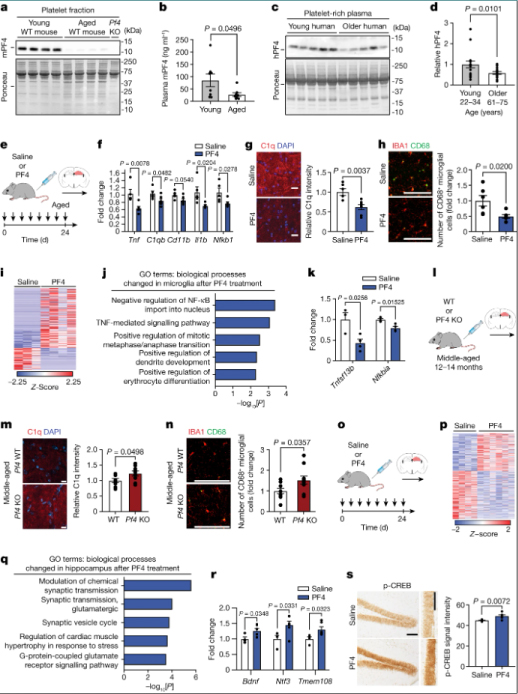
The published study reveals that the PF4 factor, released by platelets, is abundant in the blood of young mice and humans, but not in older mice or humans.
How does PF4 decrease neuroinflammation in the hippocampus?
The researchers exposed, through an injection of PF4, old mice to a fraction of the blood plasma of young mice that contained platelets. This reduced markers of brain aging and inflammation in the hippocampus, a very important brain region that is involved in memory formation, learning and spatial navigation.
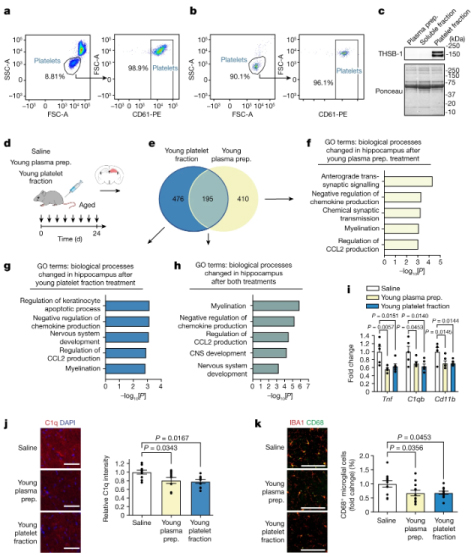
Fig. 1:Platelet factors mitigate neuroinflammation in the aged hippocampus
Based on this experiment, PF4 was found to dampen harmful inflammation in older animals by limiting microglia activation, complement activation, and pro-inflammatory gene production.
While PF4 is classified as a chemokine (a molecule that recruits immune cells to injury or infection), its protective effects in the brain are attributed to anti-inflammatory properties.
This reduction in inflammation restored the mice's cognitive ability.
How does this process work?
Reports using heterochronic parabiosis led to studies in which systemic administration of blood plasma preparations derived from young or exercised mice was shown to rejuvenate the aging brain.
These plasma preparations are largely devoid of cellular components; However, the approach universally used to generate plasma from the blood of young mice in these studies produces plasma preparations containing soluble factors and platelets 3, 4, 6, 7, 8, 9, and 10.
Therefore, we sought to define the cellular and molecular mechanisms in the blood of young animals that drive the beneficial effects of systemic administration of young blood plasma on the aged brain.
Taking this into account, it follows that platelet factors reduce neuroinflammation, and to functionally investigate the cellular components remaining in blood plasma preparations from young mice, a centrifugation-based approach was used to harvest the platelet fraction from young mice. and examined the possible beneficial effects of its systemic administration on the aging brain.
Subsequently, aged male mice were intravenously injected with the young blood plasma preparation, the young platelet fraction, or saline (100 μl per injection) 8 times for 24 days.
Fig. 2: Systemic PF4 attenuates neuroinflammation and causes synapse-related changes in the aged hippocampus.
To investigate the molecular changes caused in the aged brain by the systemic administration of the young blood plasma preparation and the young platelet fraction, we performed RNA sequencing (RNA-seq) analysis of the aged hippocampus, a brain region that It is sensitive to harmful changes.
Compared with saline-treated aged control mice, administration of the young blood plasma preparation and the young platelet fraction resulted in differential expression of the 605 and 671 genes.
Gene ontology (GO) analysis of the 195 overlapping differentially expressed genes (DEGs) in the young blood plasma preparation and young platelet fraction treatments identified changes associated with immune regulation and nervous system development.
Accordingly, we examined these markers of neuroinflammation in an independent cohort of aged male mice after systemic administration of young blood plasma preparation, young platelet fraction, or saline.
On the basis of quantitative PCR (qPCR) analysis of the hippocampus of aged mice after systemic administration of young blood plasma preparation or young platelet fraction compared to saline, a decrease in protein level was also detected. C1q in the aged hippocampus as determined by immunohistochemical analysis.
We analyzed microglia, the resident macrophages of the brain, and observed a decrease in the levels of IBA1-positive microglia expressing the lysosomal activation marker CD68 in the hippocampus of aged mice after systemic administration with blood plasma preparation young or young platelets.
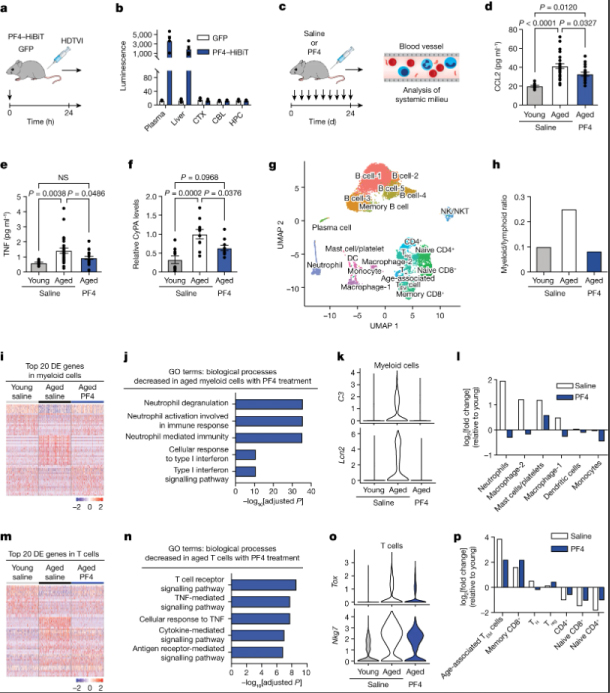
Fig. 3:Systemic PF4 restores the aging peripheral immune system to a more youthful state.
No differences in neuroinflammation markers were observed in aged male mice after systemic administration of the aged platelet fraction compared to saline.
The data indicate that systemic administration of the young plasma preparation decreases neuroinflammation in the aged hippocampus and that these benefits transfer, at least in part, to factors within the young platelet fraction. These findings also demonstrate that the benefits of young blood plasma preparation in the aged brain extend beyond the previously reported rejuvenating effects on neurogenesis and synaptic plasticity in adults.
At Enevia we care about your health, so if you want to learn more about this topic you can visit our YouTube channel, where we have a video dedicated to this discovery: https://www.youtube.com/c/EneviaHealthSL and you can also visit other articles on our blog with relevant health information at: https://test.eneviahealth.com/blog/
We use cookies to optimize our website and our service.
Functional
Always active
The storage or technical access is strictly necessary for the legitimate purpose of allowing the use of a specific service explicitly requested by the subscriber or user, or for the sole purpose of carrying out the transmission of a communication through an electronic communications network. .
preferences
The storage or technical access is necessary for the legitimate purpose of storing preferences not requested by the subscriber or user.
Statistics
Storage or technical access that is used exclusively for statistical purposes.Storage or technical access that is used exclusively for anonymous statistical purposes. Without a requirement, voluntary compliance by your Internet Service Provider, or additional records from a third party, information stored or retrieved solely for this purpose cannot be used to identify you.
Statistical
Storage or technical access is necessary to create user profiles to deliver advertising, or to track the user across one or multiple websites for similar marketing purposes.
Our groups are the ideal platform to learn and share your scientific concerns about neurodevelopment issues
Group rules:
Be nice. Bullying, insults and personal confrontations are not allowed.
Respect everyone's privacy.
Use information that is as scientific and reliable as possible, cite sources.
We want to comply with WhatsApp rules and avoid topics that we know lead to the closure of groups, so we ask that these groups not discuss topics related to VACCINES, MMS, CDS.
*Our purpose is informational only, it is not intended to be a substitute for medical advice, diagnosis or treatment.