Here we leave you the pros and cons of the FRAT so you can decide.
Autism (ASD) is often interpreted as a condition with a strong genetic component, but multiple studies suggest that there are also non-genetic heritable factors that contribute to risk.
Folate receptor alpha autoantibodies (FRAAs) are proteins that the immune system produces against the receptor that allows folate (vitamin B9) to cross the blood-brain barrier into the cerebrospinal fluid.
If these blocking antibodies are present, they can interfere with folate transport to the brain, leading to a “cerebral folate deficiency” that is linked to ASD symptoms.
In the study, two types of FRAA were measured:
FRAA blockers (which hinder receptor function)
Binding FRAA (IgG), which indicate the presence of the antibody.
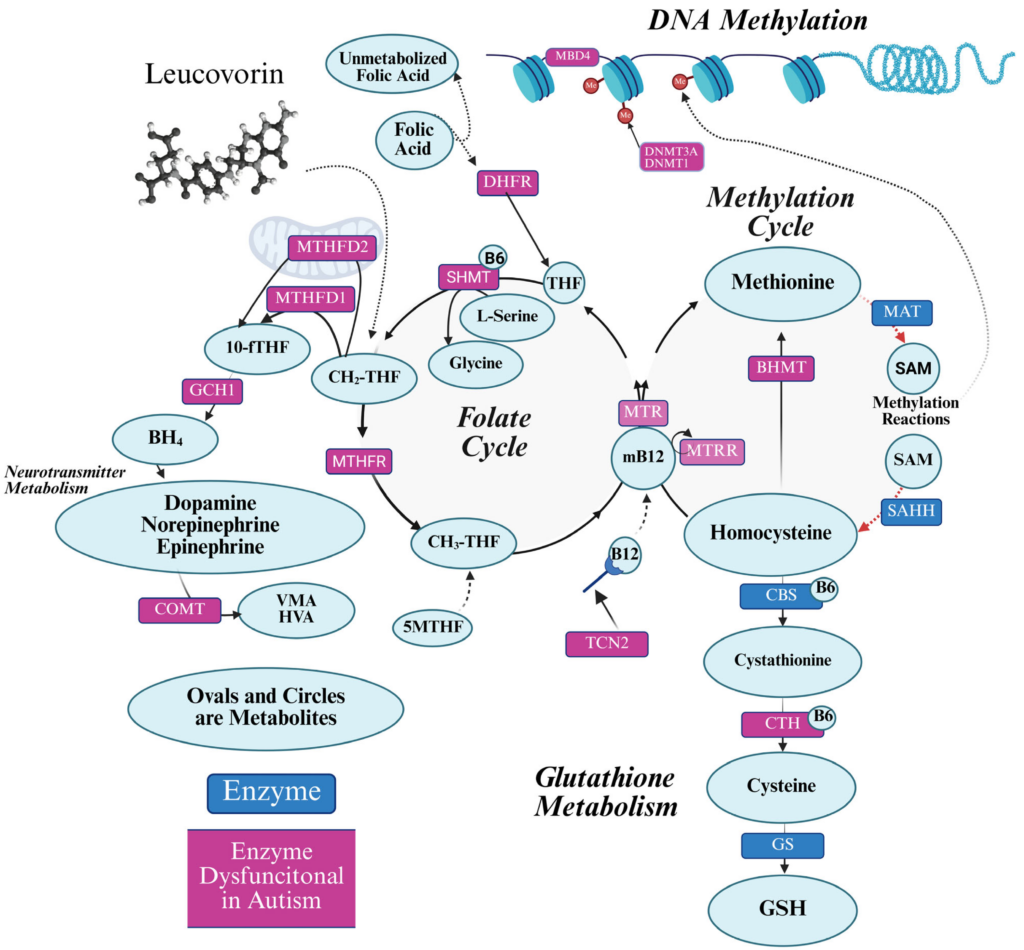
This study suggests that folate may not normally reach the central nervous system when these antibodies are present, affecting processes such as methylation, neurotransmitter production, and DNA repair, among others.
Let's talk about the study and the number of participants:
The study included 82 children with ASD, 53 undiagnosed siblings, 135 parents, and 52 control children with no history of ASD.
Families were classified as multiplex (more than one child with ASD) and simplex (only one child with ASD).
Levels of blocking and binding FRAAs were assessed in participants, looking for inheritance patterns, parent-child correlations, and intergenerational differences.
This design allows for comparing not only those affected (ASD) with controls, but also for analyzing how these antibodies act within families.
Key findings of the study
a) Higher levels in multiplex families
Families with multiple children with ASD (multiplex) had significantly higher levels of blocking FRAAs than families with one child with ASD (simplex). This suggests that in families with more cases of ASD, these autoantibodies may accumulate or have a more intense effect.
b) Increase with age and multiple pregnancies
Levels of blocking FRAAs tended to increase with parental age. Furthermore, multiple pregnancies (twins) showed higher levels, suggesting an interaction with gestational factors that could exacerbate the production of these antibodies.
c) Mother-child correlation and generational anticipation
A significant correlation was identified between the levels of blocking FRAAs in mothers and their children, raising the possibility that these antibodies may be transmitted or intensified generationally, a phenomenon known as "anticipation" in non-classical genetics.
d) Association of paternal FRAA with a worse prognosis
Fathers with positive FRAAs tended to have children with more severe ASD symptoms and poorer cognitive and behavioral development. This suggests that the presence of paternal autoantibodies is not innocuous, but may directly influence the clinical profile of the disorder.
e) Differences compared to controls
Both children with ASD and their families (siblings, parents) showed higher levels of ARF compared to controls without a history of ASD. This difference supports the hypothesis that ARF represents a hereditary risk factor, not a purely genetic one.
Folate transport across the placenta and into the nervous system
Interpretation and clinical relevance
FRAA as a non-genetic risk factor
These findings position FRAAs as a non-genetic heritable factor: that is, they can contribute to ASD risk without relying solely on DNA mutations. By accumulating or intensifying generation after generation, they could act as a type of progressive immunological burden.
Generational accumulation (“anticipation”)
The fact that levels increase in successive generations suggests that we not only inherit the genetic component of autism, but also possible immunological disorders that may increase over time in certain families.
Potential for prevention
Detecting these antibodies in couples before pregnancy could offer a window of opportunity to modulate risk. If both parents are identified as positive, medically supervised folinic acid supplementation could be considered to reduce the impact of these antibodies on fetal development.
Importance of timing and context
The effect of FRAAs may depend on each individual's metabolic, nutritional, and immunological environment. Not everyone with these antibodies develops ASD, suggesting that other factors such as nutrition, oxidative stress, microbiota, and genetics also play a role.
The FRAT test: used to measure folate receptor autoantibodies
To evaluate the presence of these autoantibodies the test is used FRAT® (Folate Receptor Autoantibody Test), a blood test that detects both blocking and binding FRAAs.
This test confirms whether folate transport to the brain may be altered by immune action. Ideally, it should be performed before pregnancy or in the early stages of pregnancy in couples with a history of ASD.
A positive result would allow for consideration of supplementation strategies (folinic acid) and closer monitoring, always with the help of a medical professional.
In the context of Dr. Frye's study, the use of FRAT testing could be essential for identifying which families are at greater immunological risk, beyond traditional genetic risk.
Recommendations for mothers and fathers planning to have another child
Perform the test FRAT before or during pregnancy to determine the status of these autoantibodies.
If positive, consider medically supervised use of folinic acid to counteract receptor blockade.
Comprehensive metabolic, nutritional, and immunological control: ensuring adequate levels of vitamins, antioxidants, and intestinal health.
More specific monitoring of pregnancy and baby development during the first year, focusing on early signs and neurodevelopment.
These recommendations do not guarantee absolute prevention, but represent a strategy based on the findings of this scientific study.
Conclusions we want to emphasize:
FRAAs act as a non-genetic hereditary risk factor in ASD, capable of being transmitted between generations.
In families with more than one affected child, these blocking autoantibodies present higher levels.
Paternal FRAA levels are associated with greater severity in offspring.
The presence of these antibodies can accumulate and enhance their effect in successive generations (anticipation).
Screening for FRAA in expectant fathers and applying folinic acid supplementation could reduce the risk, although prospective studies are needed to confirm this hypothesis.
At Enevia, we want to emphasize the importance of preventing the risks associated with developing autism and promote science-based tools that can help.
We use cookies to optimize our website and our service.
Functional
Always active
The storage or technical access is strictly necessary for the legitimate purpose of allowing the use of a specific service explicitly requested by the subscriber or user, or for the sole purpose of carrying out the transmission of a communication through an electronic communications network. .
preferences
The storage or technical access is necessary for the legitimate purpose of storing preferences not requested by the subscriber or user.
Statistics
Storage or technical access that is used exclusively for statistical purposes.Storage or technical access that is used exclusively for anonymous statistical purposes. Without a requirement, voluntary compliance by your Internet Service Provider, or additional records from a third party, information stored or retrieved solely for this purpose cannot be used to identify you.
Statistical
Storage or technical access is necessary to create user profiles to deliver advertising, or to track the user across one or multiple websites for similar marketing purposes.
Our groups are the ideal platform to learn and share your scientific concerns about neurodevelopment issues
Group rules:
Be nice. Bullying, insults and personal confrontations are not allowed.
Respect everyone's privacy.
Use information that is as scientific and reliable as possible, cite sources.
We want to comply with WhatsApp rules and avoid topics that we know lead to the closure of groups, so we ask that these groups not discuss topics related to VACCINES, MMS, CDS.
*Our purpose is informational only, it is not intended to be a substitute for medical advice, diagnosis or treatment.