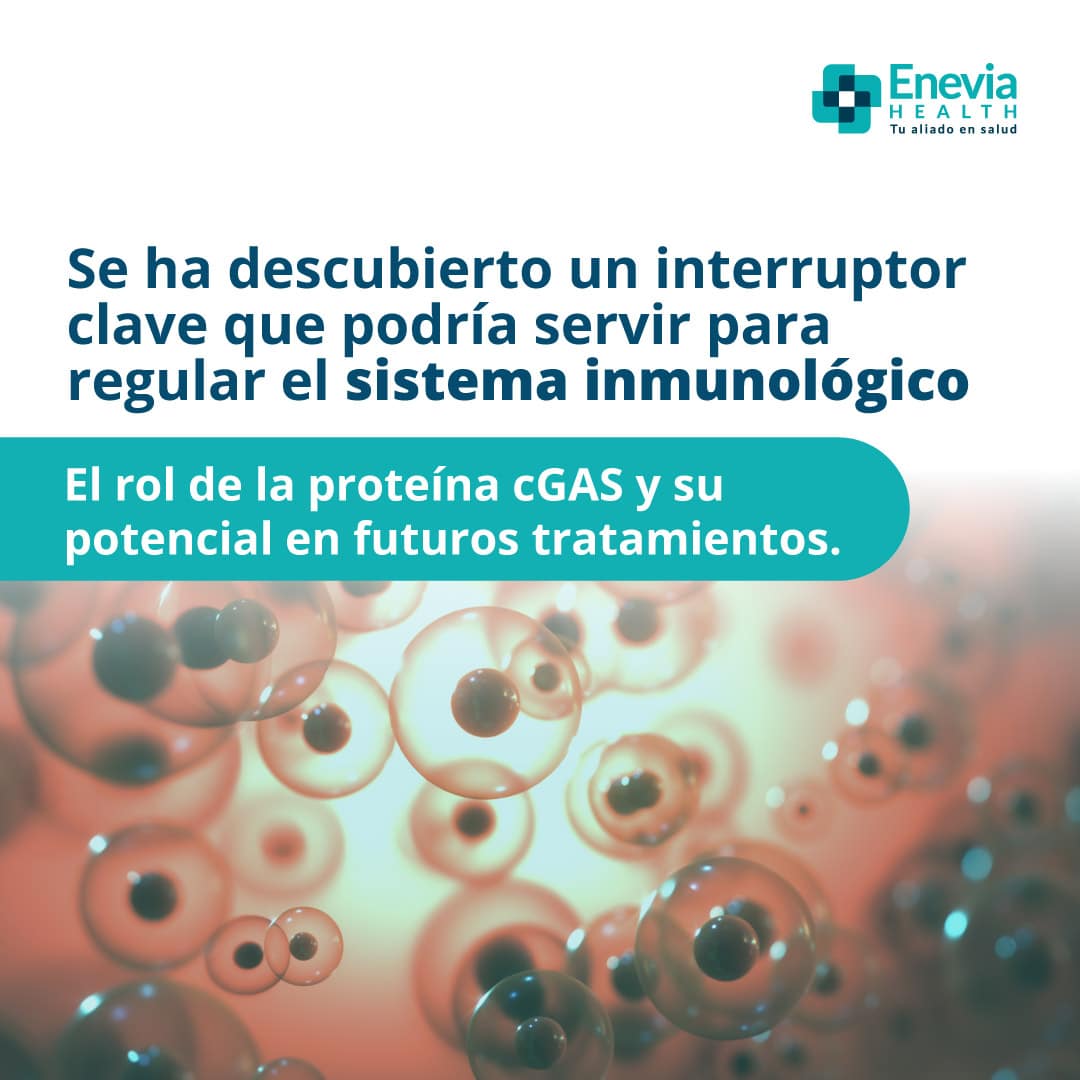
New research has discovered a key switch that could regulate the immune system and prevent it from attacking healthy cells.
The role of the cGAS (cyclic GMP-AMP synthase) protein and its potential in future treatments.
Autoimmunity is a characteristic of various autoimmune diseases. To understand why this happens, it's important to understand several aspects, including how the immune system works, the factors that trigger autoimmunity, and some of the associated diseases.
The immune system is a complex network of cells, tissues, and organs that work together to defend the body against foreign invaders such as viruses, bacteria, and fungi. Its main components include:
B lymphocytes: They produce antibodies that bind to antigens (foreign substances) and help neutralize them.
T lymphocytesThere are two main types: helper T cells, which activate other cells in the immune system, and cytotoxic T cells, which attack infected or cancerous cells.
Antigen-presenting cellsThese cells process antigens and present them to T lymphocytes, thus initiating an immune response.
B and T lymphocytes
Under normal conditions, the immune system distinguishes between the body's own cells, that is, our own cells, and foreign cells and/or substances. However, in some people, this self-recognition mechanism is broken or altered, and the immune system begins to attack the body's own cells.
Mechanisms of Autoimmunity
Something very important to keep in mind when understanding why our body attacks itself is to understand how autoimmunity can arise. It occurs through several mechanisms, including:
Loss of Immune Tolerance: Normally, during the development of the immune system, lymphocytes that react against the body's own cells are eliminated in a process called "central tolerance." If this process fails, certain lymphocytes can survive and attack the body's tissues.
Molecular MimicrySometimes, foreign invaders (such as certain viruses) can have structures similar to the body's own proteins. When the immune system responds to these invaders, it may also attack cells that contain similar proteins, due to the confusion in identifying "me" and "not me."
Genetic Factors: There is evidence to suggest that genetic predisposition may play an important role in the development of autoimmune diseases. Certain genetic variations can affect how the immune system recognizes the body's cells.
Environmental FactorsThere are several environmental factors that can trigger autoimmunity. These can include viral or bacterial infections, exposure to chemicals, and hormonal changes. For example, some women may develop autoimmune diseases during or after pregnancy.
Effects of Microbiota: The intestinal microbiotaThe gut bacteria, which consists of trillions of microorganisms living in our gut, can also influence the immune system. An imbalance in these bacteria can affect how the immune system reacts, thus contributing to autoimmunity.
Representation of autoimmunity
Autoimmune Diseases
There are more than 80 known autoimmune diseases, some of the most common include:
Rheumatoid ArthritisIn this disease, the immune system attacks the lining of the joints, causing inflammation, pain, and eventually joint damage.
Systemic Lupus Erythematosus (SLE)Lupus can affect multiple body systems, including the skin, joints, kidneys, and nervous system. It is a complex disorder with a variety of symptoms that often vary from person to person.
Multiple Sclerosis: In this disease, the immune system attacks myelin, the substance that covers nerve fibers, interfering with communication between the brain and the rest of the body.
Type 1 Diabetes: In this disease, the immune system attacks the beta cells in the pancreas that produce insulin, leading to an inability to properly regulate blood sugar levels.
Celiac DiseaseIn this condition, ingestion of gluten (a protein found in wheat, barley, and rye) triggers an immune reaction that damages the lining of the small intestine.
Autoimmune encephalitis: It is a disease that causes inflammation due to an abnormal immune response where antibodies attack various cells or structures in the brain.
Treatment and Management
Treatment for autoimmune diseases focuses on reducing immune system activity and relieving symptoms. This may include:
Immunosuppressive Drugs: They are used to reduce the immune response, helping to prevent the immune system from attacking the body's cells.
Anti-inflammatories: They help reduce inflammation and pain.
Biological TherapiesThese are newer drugs that target specific parts of the immune system.
Rehabilitation and Physiotherapy: They include exercises and therapies to help maintain mobility and quality of life.
The body's ability to attack its own cells is the result of a complex interplay between genetic and environmental factors, and mechanisms of the immune system that, for various reasons, lose their ability to distinguish between what is self and what is foreign.
Initially, cGAS (cyclic GMP-AMP synthase) was found to function in the cytoplasm, although there is evidence indicating that cGAS exists in the nucleus, where it is involved in DNA damage repair. Given the close connection between the DNA damage response and the immune response, and because cGAS recognizes DNA in length-dependent but DNA sequence-independent ways, there is an urgent need to clarify the functional balance of cGAS in the nucleus versus the cytoplasm and how it is protected from recognizing host-origin DNA.
cGAS protein
Recent studies have found that cyclic GMP-AMP synthase detects aberrant DNA during infection, cancer, and inflammatory diseases, and initiates potent innate immune responses by synthesizing 2′3′-cyclic GMP-AMP. The indiscriminate activity of cGAS toward DNA requires tight regulatory mechanisms that are necessary to maintain cellular and tissue homeostasis under normal conditions.
Within the cell nucleus, nucleosome anchoring and competition with chromatin architectural proteins together prohibit cGAS activation by genomic DNA. However, the nuclear fate of cGAS and its role in cellular physiology remain unclear. This study demonstrated that the ubiquitin proteasomal system degrades nuclear cGAS in cycling cells.
We identified SPSB3 as the cGAS-targeting substrate receptor that associates with the cullin-RING ubiquitin ligase 5 complex to link ubiquitin to nuclear cGAS. A cryo-electron microscopy structure of nucleosome-bound cGAS in complex with SPSB3 reveals a highly conserved Asn-Asn minimal degron motif at the C terminus of cGAS that directs SPSB3 recruitment, ubiquitination, and cGAS protein stability.
When mitosis occurs, i.e., when the nuclear envelope disassembles, cGAS is rapidly recruited to the chromosomes and, through this mechanism, relocates to the nuclear interior. Recent findings reported that the nuclear pool of cGAS is largely immobile and inactive. This state is achieved through the tight binding of cGAS to the acidic zone on the nucleosome surface that masks essential elements required for DNA binding and enzyme activation.
Suppression of intranuclear cGAS is further facilitated by the chromatin architectural protein BAF, which protects double-stranded DNA from cGAS binding. 15 These insights elucidated the principles of cGAS regulation within the nucleus. However, it remains unclear how cells coordinate the presence of cGAS in chromatin with general genomic maintenance processes.
Identification of SPSB3 and CUL5 in the regulation of nuclear cGAS
Representative image sequence demonstrating chromosomal binding of cGAS during mitosis followed by intranuclear redistribution and degradation in HeLa cells expressing cGAS–GFP. Each point shows the mean intensity of cGAS–GFP versus the integrated intensity. It could be observed that genes that produced increased levels of cGAS–GFP relative to the RNAi control.
Intranuclear degradation of cGAS
To determine the fate of nuclear cGAS, GFP-tagged cGAS was tracked using live-cell imaging of HeLa cells. Consistent with previous observations, they observed that, after mitosis, the abundance of nuclear cGAS progressively decreased throughout the subsequent cell cycle.
Image-based quantitative cytometry analysis revealed a continuous decrease in nuclear cGAS from the G1 to G2 phase of the cell cycle, which was most pronounced in G1 and accompanied by a complementary increase in cytosolic cGAS levels. During mitosis, when cGAS co-localizes with chromatin, no additional change in cGAS levels was recorded. The researchers verified these observations in naive HeLa cells and confirmed that the nuclear pool, but not the cytosolic pool, of endogenous cGAS gradually decreases during interphase.
Intranuclear degradation of cGAS was demonstrated in HeLa cells expressing cGAS-GFP and PCNA.
As the host's first line of defense, innate immunity seeks to ward off external attacks from microbes or viruses. Depending on the type of pathogen, there are several pattern recognition receptors in the cytoplasm that detect attacks from internal sources.
external or host, which triggers the immune response to fight infections.
Among them, cGAS is the main pathway that responds mainly to microbial DNA, DNA virus infections, or self-DNA, which mainly originates from genome instability byproducts or DNA released from mitochondria.
DNA sensors
There are many DNA sensors in the cytoplasm; although some of them can also respond to RNA, here we will be able to comment on some of the group of sensors that can trigger the immune response under DNA attack, in which some of them are particularly in the immune response pathway; although some are classical DNA repair factors, these DNA repair factors exist both in the nucleus and in the
cytosol, and perform different functions under certain conditions.
These DNA sensors include:
DNA-dependent activator of IFN regulatory factors (DAI)
LRR-interacting protein 1 (in Flightless I) (LRRFIP1)
DEAD (Asp-Glu-Ala-Asp) polypeptide 41 (DDX41).
Absent from AIM2.
IFN-g-inducible protein 16 (IFI16) recognizes pathogenic DNA in both the cytoplasm and the cell nucleus.
DHX36 and DHX9, their deletion leads to the induction of significantly reduced IFN-I or TNF-α responses when confronted with the DNA virus
High Mobility Group (HMGB).
The Ku70 heterodimer.
The MRE11 gene, a negative regulator of human DNA mismatch repair.
Cyclic GMP AMP synthase (cGAMP) (cGAS).
Caspase-1-activating inflammasome with apoptosis-associated speck-like protein containing a CARD (ASC).
DAI, also known as DNA-binding protein-Z 1 and DLM-1
ICD, due to its ability to bind double-stranded DNA, was identified as the first cytoplasmic DNA sensor after TLR9, activating NF-kB by binding to the TRAF family-associated activator of NF-kappa-B-binding kinase 1 (TANK) (TBK1) and the IFN regulatory factor 3 (IRF3) complex.
However, whether DAI plays a relevant role in DNA sensing requires further experimental verification. LRRs are key motifs in the TLR domain responsible for recognizing PRRs, and cytoplasmic LRRFIP1 was found to bind double-stranded DNA and double-stranded RNA, but not single-stranded DNA and single-stranded RNA.
Recent studies have shown that cGAS exists in the nucleus and is associated with DNA damage-induced genomic instability. DNA damage itself leads to the formation of micronuclei; cGAS in the cytoplasm can co-localize with broken DNA and recognize it in micronuclei, following activation of the cGAS-STING-dependent immune response.
cGAS-dependent genomic instability in the nucleus and immune-related genomic instability in the cytosol make it critical to understand the mechanism of cGAS transport between the cytoplasm and the nucleus, and how cGAS was restricted to recognizing self-DNA under unperturbed conditions.
cGAS structure
To date, most studies on cGAS have focused on its function in immune responses to the cytosol. Because there is growing evidence that cGAS is permanently localized in the nucleus as a chromatin-binding protein, it will be interesting for future immunology and genetics to further investigate its function in the nucleus, especially from the perspective of post-translational modification of genetic material.
Repair processes
Ubiquitination is the ubiquitin proteasome pathway, which is involved in the intracellular turnover of proteins and plays an important role in the degradation of short-lived regulatory proteins, involved in a wide range of cellular processes such as: regulation of the cell cycle, modulation of surface receptors and ion channels, processing and presentation of antigens and activation of transcription factors.
Sumoylation (SUMOylation) is a post-translational modification by which some cellular proteins are covalently modified by the addition of another small protein called SUMO (small ubiquitin-related modifier).
Methylation is the process where methyl groups are added, this action of maintenance DNA methyltransferases causes DNA to be methylated at the beginning of replication, and for this reason the patterns are inherited in a semi-conservative manner and can be perpetuated in the cell population.
These are processes that have been observed in various studies and that occur in the nucleus, and they help us unravel many interesting and urgent questions that many researchers need to resolve.
Investigating their activity, protein-protein interactions, chromatin binding, chromatin release, nuclear closure to the cytosol, and immune inhibition, among other actions, is essential to understanding the process of autoimmunity.
At Enevia we offer specialized consulting services and different tests that can guide you in different areas such as neurology, genetics, nutrition and general medicine, as well as help you make the right decisions and analyze medical tests to achieve effective treatment for the pathologies that you may suffer from.
Article written by Enevia's Advisors and Collaborators: Dr. Julianny Albarran, Surgeon, general medicine with more than 5 years of experience in the area and the Eng. Yohana Céspedes, Chemical Engineer and ASD mom.
Also, on our blog, we have more interesting articles on immunology, primary immunodeficiencies in neurodevelopmental disorders, and much more that might be of interest to you or your loved ones. Below are some of them:
We use cookies to optimize our website and our service.
Functional
Always active
The storage or technical access is strictly necessary for the legitimate purpose of allowing the use of a specific service explicitly requested by the subscriber or user, or for the sole purpose of carrying out the transmission of a communication through an electronic communications network. .
preferences
The storage or technical access is necessary for the legitimate purpose of storing preferences not requested by the subscriber or user.
Statistics
Storage or technical access that is used exclusively for statistical purposes.Storage or technical access that is used exclusively for anonymous statistical purposes. Without a requirement, voluntary compliance by your Internet Service Provider, or additional records from a third party, information stored or retrieved solely for this purpose cannot be used to identify you.
Statistical
Storage or technical access is necessary to create user profiles to deliver advertising, or to track the user across one or multiple websites for similar marketing purposes.
Our groups are the ideal platform to learn and share your scientific concerns about neurodevelopment issues
Group rules:
Be nice. Bullying, insults and personal confrontations are not allowed.
Respect everyone's privacy.
Use information that is as scientific and reliable as possible, cite sources.
We want to comply with WhatsApp rules and avoid topics that we know lead to the closure of groups, so we ask that these groups not discuss topics related to VACCINES, MMS, CDS.
*Our purpose is informational only, it is not intended to be a substitute for medical advice, diagnosis or treatment.